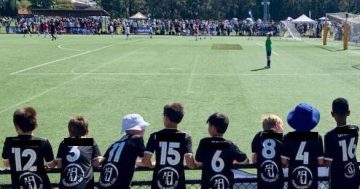



The liquidator’s investigation into the collapsed Gungahlin United Football Club continues, but court action is being considered. Photo: GUFC.
Gungahlin United Football Club’s liquidator is considering dragging former committee members to court-sanctioned hearings to find out if they committed any offences.
The liquidator, Ezio Senatore, is also seeking legal advice to determine whether court action could recover the deposit funds paid by families and players.
In his statutory report, Mr Senatore concluded the club’s books and records were not adequate to enable the former or current executive committee to comply with their obligations, and it appeared GUFC had been operating while insolvent from at least 31 December 2021.
“There are a number of offences committed by some of the former Executive Committee members,” he wrote.
“I note that the former President has not cooperated with my investigations. Apart from my initial meeting, the former President failed to respond to my formal notices, emails, and telephone messages.
“As a result, I will now consider conducting a court-sanctioned public examination of certain officers regarding the affairs of the club.”
Directors can be held personally liable for the debts of a club in certain circumstances under the Corporations Act.
A report on the club’s affairs and property (or ROCAP, prepared by the GUFC committee) listed $34,673.55 in cash in the bank and $38,901.80 in equipment, resulting in total assets of $73,575.35.
But there was also $682,032.40 in unsecured creditors, leaving the club with a total deficiency of $608,457.05.
When Mr Senatore examined the club’s books and records, those documents stated that there was, in fact, $399,089.59 in the bank, plus assets in accounts receivable and equipment, resulting in total assets of $480,402.19.
The records indicated that there was only $224,849.17 in unsecured creditors, resulting in an estimated surplus of $255,553.02.

A comparison of club records with the ROCAP and amounts realised to date in the liquidation. Photo: Supplied.
Mr Senatore said the club failed to keep its records up to date and had not undertaken any regular reconciliations.
“[A] reported profit in [financial year] 2024 was recorded while the club remained in a net asset-deficient position and was experiencing ongoing liquidity constraints,” he wrote.
“Further, the FY24 financial statements appear to be materially misstated due to the failure to properly account for income received on a trust represented by player fees paid in advance.”
Mr Senatore expressed concerns about the auditor who examined the club’s FY2021 documents, noting that this person had failed to report a “going concern issue” regarding the club’s ability to improve its trading results and continue operating. This warning was repeated for the 2022 financial statements.
“I have concluded that the auditor may have failed in his duty to report a going concern issue,” Mr Senatore wrote.
“This will be subject to my further investigations.”
Mr Senatore requested that all funds held by the club’s bank be transferred into the liquidation account.
He received a total of $34,673.55.
The liquidator sold the club’s equipment, resulting in the recovery of $20,025.00.
In terms of the money owed, there are currently 87 unrelated unsecured creditors who are owed a combined total of about $537,496.78.
Some of the creditors include the ACT Government (owed $184,451.71 for sportsground hire), the Australian Taxation Office ($76,500), various coaches, referee fees, other clubs and players.
Mr Senatore doesn’t expect any payments will be able to be made to “any class of creditor”, with one caveat: “I will be seeking legal advice and, if required, direction from the court on my ability to attempt to return deposits paid by some families for payments made to secure Premier League positions for junior players from funds available in the liquidation, subject to costs.”
He noted that pursuing legal action could come with considerable costs, but that creditors could also fund any recovery action.
Original Article published by Claire Fenwicke on Region Canberra.